Planning the future in a complex environment needs collective imagination. The best plans emerge when people with different perspectives imagine their future together.
The University of California, Irvine’s School of Social Ecology has an ambitious mission: to solve society’s most pressing environmental and social problems. Like so many other academic institutions, the School is facing disruptive change. Public policies are shifting, student expectations are growing, and AI is influencing research and teaching. The School’s planning question was less about where it should be in five years, and more about how to plan when no one knows what the next five years will bring.
When the Dean asked me to facilitate the School’s strategic planning process, I recommended we begin in an unexpected place. Before our first meeting, I asked each committee member to complete a short assignment. Working alone, each person identified twenty-four external forces that could influence the School’s future. They considered three possibilities in eight categories, including economics, technology, and culture. Some were likely and some seemed very unlikely. The goal wasn’t to predict the future, but to stretch the committee’s imagination beyond the obvious.
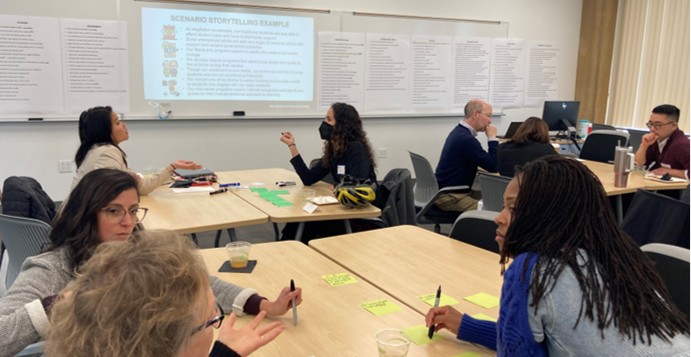
By the time we gathered for our first strategy workshop, the walls were filled with several hundred possible futures. Some contradicted each other and others were complimentary. Together they represented a broad view of the School’s possible future.
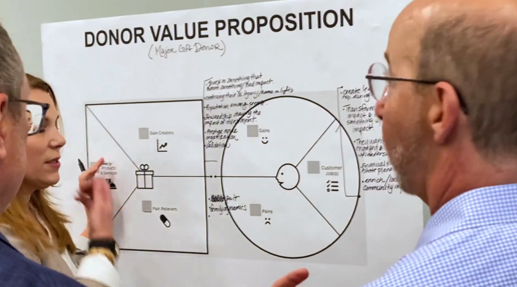
As the group began clustering ideas into themes, different perspectives emerged. Faculty members saw the implications for research. Staff members focused on operational constraints and alternatives. Graduate students recognized possibilities that the others hadn’t considered. Together these perspectives painted a rich picture of the School’s future challenges and opportunities.
This is my favorite turning point in strategic planning. When a group of people with diverse experiences begins to hear one another, and build on their own perspectives, they are ready to imagine a shared future.
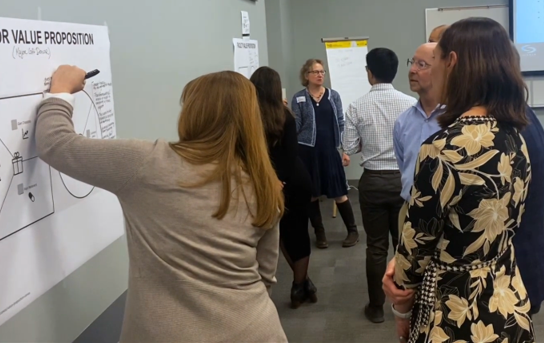
After the committee identified two environmental factors that seemed both important and uncertain, they began to work on the four corners of a matrix where these factors met. Four smaller groups explored the same questions. If this combination of events occurred, how would it impact research, teaching, and the partnerships essential to success?
As the four scenarios developed, the conversations were even more creative. Committee members began thinking less as representatives of their roles and more as stewards of the School’s future. At that point I knew they were ready to synthesize their thinking into a unified direction.
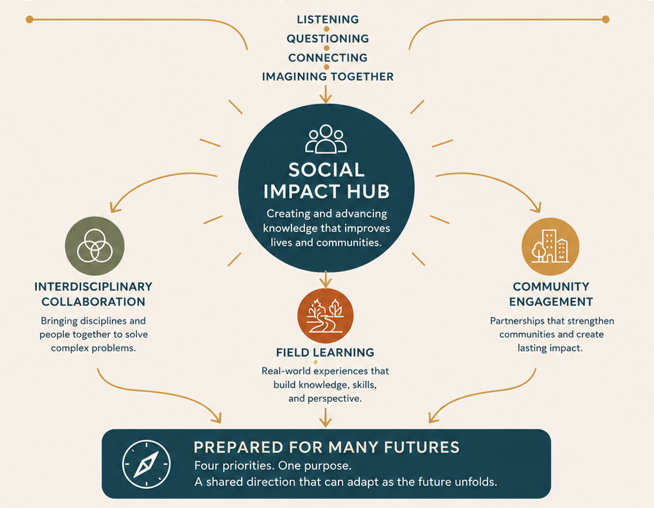
Comparing the four scenarios side-by-side revealed four common threads. Though each scenario suggested a different set of challenges and opportunities, four strategic priorities were shared by all of them. It was clear the School could thrive by strengthening interdisciplinary collaboration; expanding field-based learning; deepening community partnerships; and building a hub of positive social impact.
The four priorities emerged because they proved valuable in every future the committee could imagine. Going forward, the School has a set of strategic initiatives to shape and implement. Just as important, they have four potential scenarios that create a framework for observing changes in their environment and responding proactively.
After facilitating strategic planning for many years, experiences like these continue to shape how I approach the work. Organizations don’t lack intelligent people, but they often lack a process that helps those people see beyond their own perspectives. My role is to create the space where patterns emerge from a group that no individual would recognize alone. The most valuable outcome of this strategy work isn’t a document. It’s the shared understanding that develops as it’s created. Once people have imagined their future together, they’re ready to shape it together.