

After practicing design thinking for more than two decades, I’ve experienced its benefits firsthand. Our clients have developed solutions that better meet user needs, their products and services have been adopted more quickly, and collaboration has improved across organizational boundaries.
The business impact can be substantial as well. One study found that companies with a strong focus on design achieved 32% higher revenues and 56% higher profits than their competitors.[i] But an important question remains: What is it about design thinking that creates these outcomes?
Research by Jeanne Liedtka and Kristina Jaskyte Bahr offers some intriguing answers.[ii] Their study examined 471 people who use design thinking and explored the relationship between specific practices and the outcomes they reported. The authors emphasize that their findings are preliminary, but the research offers three useful insights into what makes design thinking effective.
One: Design thinking creates more than better solutions.
The researchers identified five types of positive outcomes associated with design thinking: better solutions; improved implementation and adaptation; individual psychological benefits; stronger networks and resources; and trust building. Two of these benefits rose to the top. Solution quality received the highest average rating, with trust building close behind.
That second finding is particularly interesting. Design thinking appears to affect not only what a team creates, but also how people work together while creating it. Several practices were associated with trust: forming diverse teams, listening actively, generating a range of ideas, seeking feedback from users and other stakeholders, and conducting real-world experiments. The process can strengthen both the solution and the relationships behind it.
Two: The complete process matters.
The research also discovered an interesting imbalance in how design thinking is practiced. Activities at the beginning of the process – understanding users and generating ideas – were used most frequently. Prototyping, testing multiple ideas, and conducting real-world experiments were among the less frequently used practices.
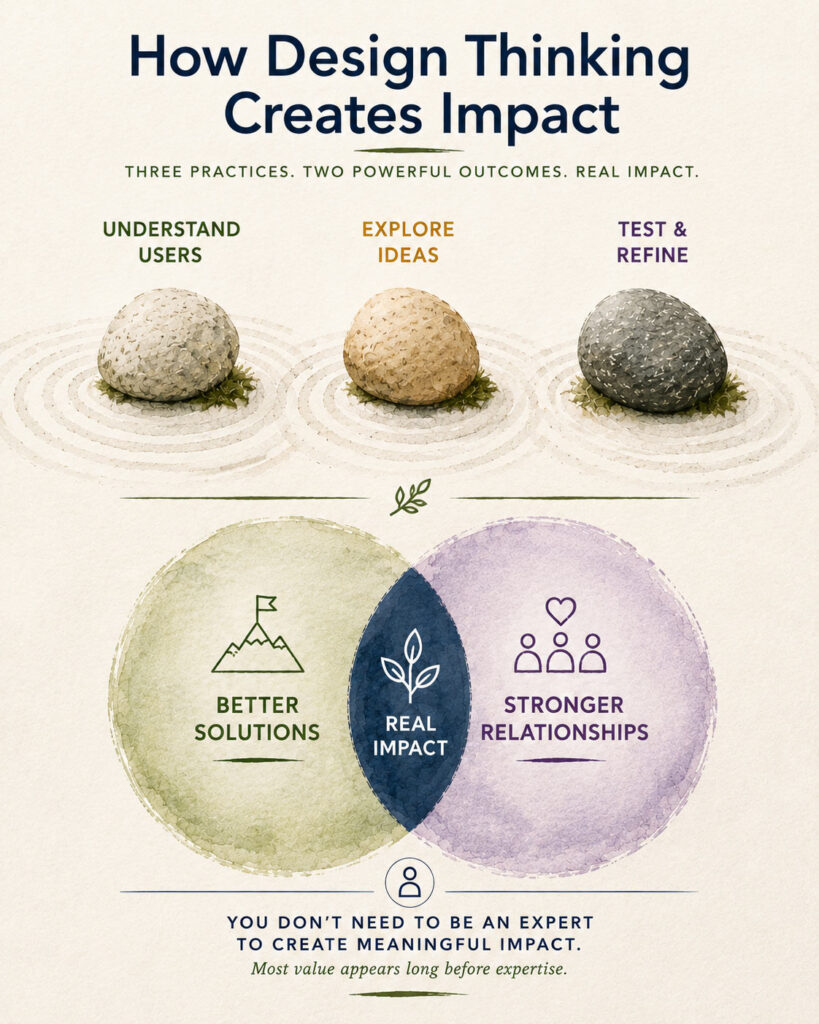
It’s a familiar temptation: do the discovery, generate possibilities, and then move quickly toward the idea that initially feels most promising. But testing matters. Real-world experimentation was associated with four of the five positive outcomes in the study. The findings suggest that design thinking gains power when teams keep learning rather than treating the first promising idea as the answer.
Three: You don’t have to be an expert.
Perhaps the most encouraging finding is that many of design thinking’s benefits appear well before someone becomes an expert. The level of experience needed varied by outcome. Trust building appeared with relatively limited experience, while developing stronger solutions benefited from greater proficiency. But even for solution quality, moving from moderate to expert experience produced no significant additional benefit in the study.
That has an important implication for organizations: design thinking need not remain the province of specialists. People throughout an organization can learn to listen more carefully, bring different perspectives into the conversation, explore possibilities, and test ideas together.
As a frequent design thinking practitioner, that finding resonates with me. Its value isn’t simply that it helps us create better solutions. The process can also change how people listen, learn, and work together. That’s the real power of design thinking: it improves both what we create and how we create it together.
[i] Sheppard, B., Kouyoumjian, G., Sarrazin, H., & Dore, F. (2018). The business value of design. McKinsey Quarterly. Retrieved from https://www.mckinsey.com/business-functions/mckinsey-design/our-insights/the-business-value-of-design
[ii] Liedtka, J., & Bahr, K.J. (2019). Assessing design thinking’s impact: Report on the development of a new instrument DSWP 19-13. Darden Working Paper Series. University of Virginia Darden School of Business.